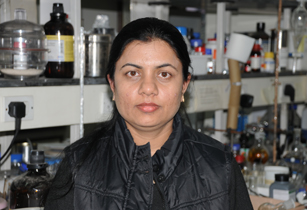
वीना शिवगौड़ा पाटिल
Research Interest:
Summary of Research:Human immunology, Infectious diseases, Non-coding RNAs, Genomics
We are a lab of human immunology, interested in understanding the overall immune response to infections. Our main focus is to understand the development of immune response by studying the regulation of global gene expression patterns uniquely associated with a pathogen, immune cell-type and/ disease stage using multi-omics and immunological tools. Two major research activities in the lab are:
1. T cell memory development to infectious diseases
The acquisition of immunological memory to infections is a hallmark of protective immunity and hence forms the basis for vaccinations. During this evolutionarily conserved process of T cell immunological memory development, the naive T cells that have not previously encountered antigen, differentiate during the primary infection into memory T cells that have specialized functions in immune defence to a later infection with the same pathogen. Each pathogen elicits a specialized memory subset and once formed this specialized T cell memory can provide life-long immunity to the same pathogen. My lab is mainly interested in understanding how the T cell memory is formed during the primary infection and maintained over the years to defend the subsequent secondary infection from the same pathogen. For examples, currently our lab is focused on understanding the protective role of CD4+ cytotoxic memory T cells in viral infections (dengue virus, cytomegalovirus, EBV, Influenza) and various CD4+ T helper memory subsets in bacterial infection (Mycobacterium tuberculosis). Broadly, our research goal is to understand the biology of such specialized memory subsets and utilize this knowledge in designing and developing strategies to boost durable immune responses following therapeutics and vaccination against these pathogens.
2. Immune response to sepsis in neonates
The host immune response to neonatal sepsis is very poorly understood. The little we know about immune response in neonatal sepsis comes from whole blood analysis majorly due to limited availability of sample volume. However, the blood transcriptome can be heavily confounded by higher frequency of one or two dominant immune cell types. Analysing the dynamic change in immune cell proportions and the associated immune cell-type specific gene expression patterns will provide better understanding of the immune response to neonatal sepsis. In this specific project we are trying to understand the dynamic changes in immune response by examining the dynamic changes in proportion of immune cell subsets and their associated global gene expression pattern.
Group Members:
Raunak Kar (PhD Student 2019 batch), Kirti Sharma (PhD student 2020 batch), Shreya Sinha (PhD student 2022 batch), Sarojini Minj (Technical Officer), Nandlal Arya (Technician), Fajar PM (MS student), Aparna Rai (JRF), Imam (SRF)
Raunak Kar (PhD Student 2019 batch), Kirti Sharma (PhD student 2020 batch), Shreya Sinha (PhD student 2022 batch), Sarojini Minj (Technical Officer), Nandlal Arya (Technician), Fajar PM (MS student), Aparna Rai (JRF), Imam (SRF)
Funding:
The lab is funded by DBT-WT India Alliance, DBT and NII.
Publications:
After joining National Institute of Immunology, New Delhi (NII)
- Chongtham, C., Biswas, T., Kumari, N., Kar, R., Jayalakshmi, J. S., Pant, A., Patil, V. S., Arimbasseri, G. A., 2026. JNK2 pathway in colonocytes enhances gut barrier integrity in response to microbial acetate. Gut Microbes, VOL. 18, NO. 1, 2651962.
- Kar R, Sinha S, Khatun Z, Sharma A, Patil VS*, 2026. A distinct subset of stem-cell memory is poised for the cytotoxicity program in CD4+ T cells in humans. Science Advances 12 (2), eady6423.
- Jawla N, Kar R, Patil VS, and Arimbasseri AG, 2024. Inherent metabolic preferences differentially regulate the sensitivity of Th1 and Th2 cells to ribosome-inhibiting antibiotics. Immunology. 2024;1–19.
- Kar R, Chattopadhyay S, Sharma A, Sharma K, Sinha S, Arimbasseri GA*, and Patil VS*, 2024. Single-cell transcriptomic and T cell antigen receptor analysis of human cytomegalovirus (hCMV)-specific memory T cells reveals effectors and pre-effectors of CD8+- and CD4+-cytotoxic T cells. Immunology.172 (3); 420-439.
- Yadav P, Rana K, Nardini V, Khan A, Pani T, Kar A, Jain D, Chakraborty R, Singh R, Jha SK, Mehta D, Sharma H, Sharma RD, Deo SVS, Sengupta S, Patil VS, Faccioli LH, Dasgupta U, Bajaj A, 2024. Engineered nanomicelles inhibit the tumour progression via abrogating the prostaglandin-mediated immunosuppression. Journal of Controlled Release 368, 548-565.
- Kar A, Jain D, Kumar S, Rajput K, Pal S, Rana K, Kar R, Jha Sk, Medatwal N, Yavvari PS, Pandey N, Mehta D, Sharma S, Bhattacharya D, Pradhan MK, Sharma RD, Srivastava A, Agrawal U, Mukhopadhyay A, Sengupta S, Patil VS, Bajaj A, Dasgupta U, 2023, A localized hydrogel-mediated chemotherapy causes immunogenic cell death via activation of ceramide-mediated unfolded protein response. Science Advances 9 (26), eadf2746.
- Verma P, Arora A, Rana K, Mehta D, Kar R, Verma V, Srikanth CV, Patil VS, Bajaj A, 2022, Gemini lipid nanoparticle (GLNP)-mediated oral delivery of TNF-α siRNA mitigates gut inflammation via inhibiting the differentiation of CD4+ T cells. Nanoscale, 14(39), 14717-14731
- Rana K, Pani T, Jha SK, Mehta D, Yadav P, Jain D, Pradhan MK, Mishra S, Kar R, Reshma GB, Srivastava A, Dasgupta U, Patil VS*, and Bajaj A*, 2022, Hydrogel-mediated Topical Delivery of Steroids Can Effectively Alleviate Psoriasis via Attenuating the Autoimmune Responses. Nanoscale, 14, 3834-3848.
- Kumar S, Pal S, Thakur J, Rani P, Rana K, Kar A, Kar R, Mehta D, Jha SM, Pradhan MS, Jain D, Rajput K, Mishra S, Ganguli M, Srivastava A, Dasgupta U, Patil VS, Bajaj A. 2021. Nonimmunogenic Hydrogel-Mediated Delivery of Antibiotics Outperforms Clinically Used Formulations in Mitigating Wound Infections ACS Applied Materials & Interfaces. 13 (37), 44041-44053.
- Pal S, Soni V, Kumar S, Jha SM, Medatwal N, Rana K, Yadav P, Mehta D, Jain D, Sharma P, Kar R, Srivastava A, Patil VS, Dasgupta U, Nandicoori VK, Bajaj A. 2021. A hydrogel-based implantable multidrug antitubercular formulation outperforms oral delivery. Nanoscale, 13 (31), 13225-13230.
Before joining NII (before 2019)
- #Zhang Q, #ChaoT, #Patil VS, Qin Y , Tiwari SK , Chiou J , Dobin A, Tsai C, Li1 Z , Dang J , Gupta S, Urdah K , Nizet V, Gingeras TR, Gaulton K and Rana TM. 2019. The long noncoding RNA ROCKI regulates inflammatory gene expression. The Embo J 38:e100041/2019.
- Patil VS, Madrigal A, Schmiedel BJ, Clarke J, O'Rourke P, deSilva AD, Harris E, Peters B, Seumois G, Weiskopf D, Sette A and Vijayanand P, 2018. Precursors of human CD4+ cytotoxic T lymphocytes identified by single-cell transcriptome analysis. Science Immunology 3, eaan8664 (2018).
- Tian Y, Babor M, Lane J, Schulten V, Patil VS, Seumois G, Burel J, De Silva AD, Premawansa S, Premawansa G, Wijewickrama A, Vijayanand P, Weiskopf D, Sette A, Peters B. 2017. Unique phenotypes and clonal expansions of human CD4 effector memory T cells re-expressing CD45RA. Nature Communications 8, 1473 (DOI: 10.1038/s41467-017-01728-5).
- Dang J, Tiwari, SK, Gianluigi Lichinchi, Yue Qin, Patil VS, Alexey M. Eroshkin, and Tariq M. Rana. 2016. Zika Virus Depletes Neural Progenitors in Human Cerebral Organoids through Activation of the Innate Immune Receptor TLR3. Cell Stem Cell 19, 1–8, July 7, 2016.
- #Patil VS, #Anand A, Chakrabarti A, and Kai T. 2014. The Tudor domain protein Tapas, a homolog of the vertebrate Tdrd7, functions in the piRNA pathway to regulate retrotransposons in germline of Drosophila melanogaster. BMC Biology, 12:61.
- #Sakurai K, #Talukdar I, #Patil VS, Dang J, Li Z, Chang KY, Lu CC, Delorme-Walker V, Dermardirossian C, Anderson K, Hanein D, Yang CS, Wu D, Liu Y, Rana TM. 2014. Kinome-wide functional analysis highlights the role of cytoskeletal remodeling in somatic cell reprogramming. Cell Stem Cell. 2014;14(4):523-34.
- Li Z, Chao TC, Chang KY, Lin N, Patil VS, Shimizu C, Head SR, Burns JC, Rana TM. 2014. The long noncoding RNA THRIL regulates TNFα expression through its interaction with hnRNPL. Proc Natl Acad Sci U S A. Jan 21;111(3):1002-7.
- Patil VS and Kai, T. 2010. Repression of Retroelements in the Drosophila Germline via piRNA Pathway by the Tudor Domain Protein Tejas. Current Biology 20: 734-730.
Reviews
- Patil VS, Zhou R, Rana TM. 2014. Gene regulation by non-coding RNAs. Crit Rev Biochem Mol Biol. Jan-Feb;49(1):16-32.
- #Pek, JW, #Patil VS and Kai, T. 2012. piRNA pathway and the potential processing site the nuage, in the Drosophila germline. Develop. Growth Differ. 54, 66–77.
*Corresponding author,
#Equal contribution (first co-author)